About the Lab
Meet our PI, learn about scanning tunneling microscopy, and discover what our instruments can reveal about quantum matter.
Prof. Vidya Madhavan

Prof. Vidya Madhavan
Donald Biggar Willett Professor in Engineering · Department of Physics · University of Illinois Urbana-Champaign
Prof. Madhavan's research focuses on using scanning tunneling microscopy and spectroscopy to understand the electronic properties of quantum materials at the atomic scale. Her group has made important contributions to the understanding of topological materials, strongly correlated electron systems, and unconventional superconductors.
In 2026, Vidya was elected a member of the prestigious National Academy of Sciences. In 2025, she started her role as the newest Department Head of Illinois Physics.
What is Scanning Tunneling Microscopy?
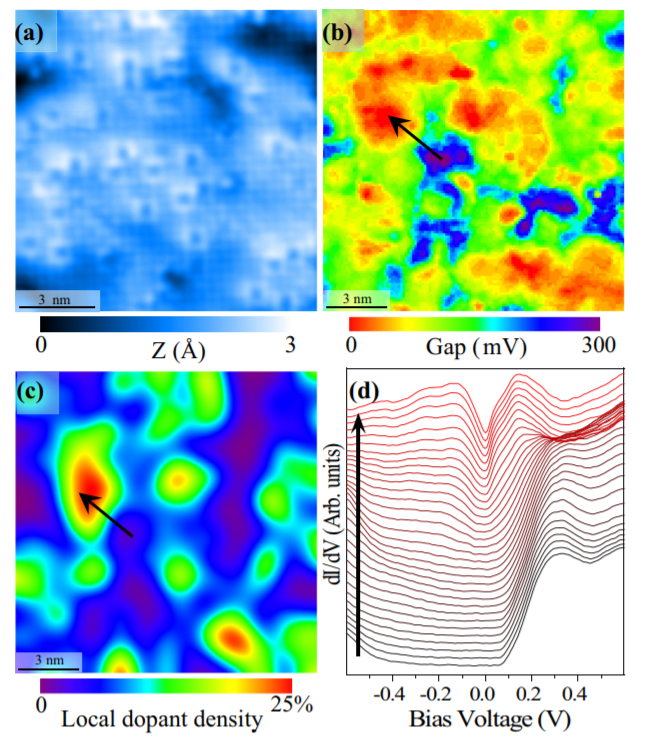
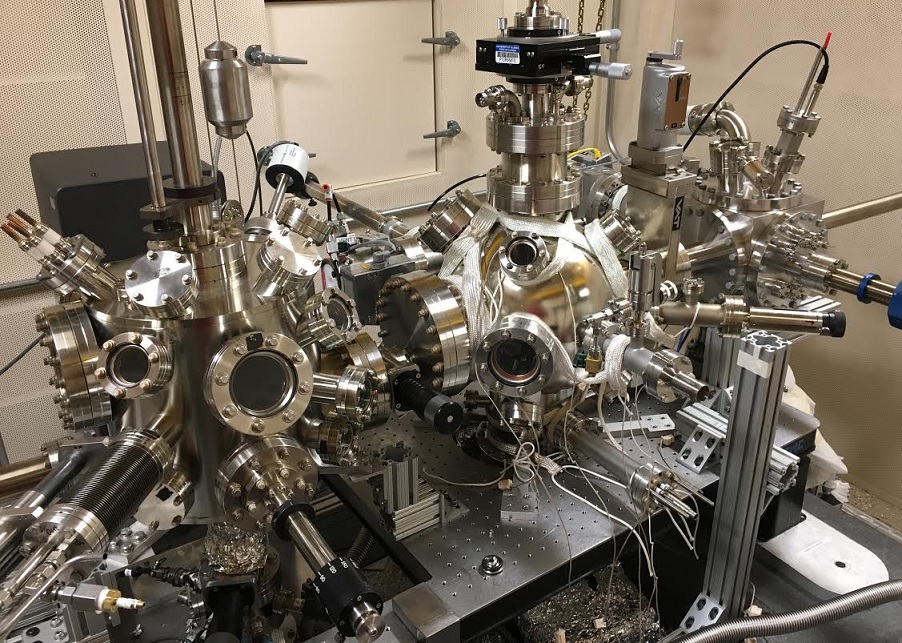
In a Scanning Tunneling Microscope (STM), a metallic, atomically sharp tip gets extremely close to a sample, allowing electrons to quantum mechanically tunnel from the sample to the tip or vice versa. This tunneling decreases exponentially with distance, giving STM its unparalleled spatial resolution.
Due to the quantum mechanical nature of the tunneling, STM is able to gain information about how electronic states vary with energy and position — a quantity known as the local density of states. Since electrons can tunnel from the sample to the tip and from the tip to the sample, STM can study both the occupied and unoccupied states of a material.
The high-resolution access to the local density of states and the ability to probe both occupied and unoccupied states makes STM an indispensable tool in the study of quantum materials.
Atomic Resolution
STM can resolve individual atoms on a surface, achieving spatial resolutions below 0.1 nm — revealing the true atomic structure of materials.
Local Density of States
By measuring tunneling current as a function of voltage (dI/dV), we map the local density of states with meV energy resolution and atomic spatial precision.
Both Occupied & Unoccupied States
Unlike many probes, STM can access states both below and above the Fermi level, providing a complete picture of the electronic structure.
Probing Quantum Phenomena at the Atomic Scale
Topological Materials
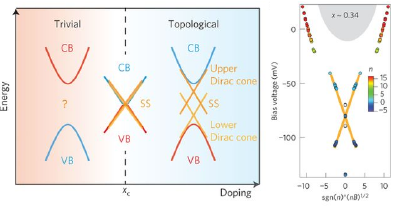
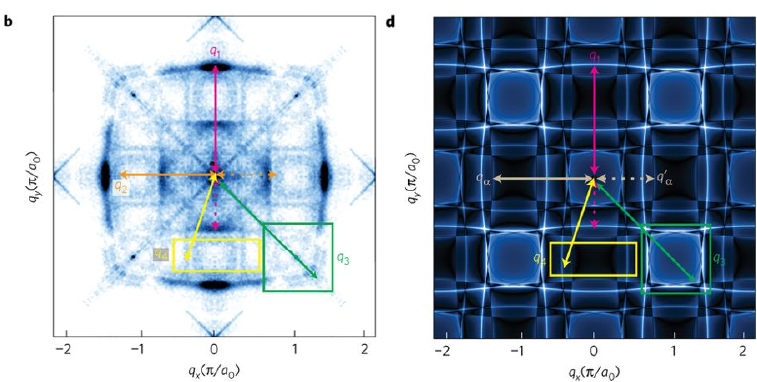
STM can directly image the hallmark signatures of topological matter — surface states, Dirac cones, and Majorana-bound states — in real space and energy space simultaneously. A material that is topologically non-trivial has an electronic "shape" that is mathematically distinct from a normal material, leading to unique protected states at interfaces.
Unconventional Superconductivity
The superconducting gap, its momentum-space symmetry, and quasiparticle excitations within vortex cores are all directly accessible by low-temperature STS. Since the discovery of high temperature superconductors in the late 80s, unconventional superconductors have hosted several competing emergent phenomena and remain one of the most pressing research areas in condensed matter physics.
Strongly Correlated Electrons
In strongly correlated electron systems, electron-electron interactions cannot be treated as small perturbations. These interactions are responsible for entirely new states of matter like Mott Insulators, Wigner Crystals, and Heavy Fermions. Since strongly correlated materials are known for their very local properties, STM is uniquely suited to study these systems.